Friday, February 20, 2009
Nice Work updates on Fridays!
1961! Kennedy! the Mob! Castro! in The Wild, Wild West with Johnny Cat, Sinatra-stand-in supreme! Every Friday at Modern Tales and Webcomicsnation! Here's a taste:

Tuesday, February 17, 2009
Frank Robbins saves the NYC Comic-Con
 Lissen, I didn't have a great NYC Comic-Con. Sales were slow, and I was wearing some kind of invisibility cloak or something-I don't know. How do you make the best out of a bad at a comic con? Buy some original comic strip art! So dig it-I picked up a daily "Johnny Hazard" by one of my all-time favorite cartoonists-Frank Robbins.
My first introduction to Robbins' work was as a writer for a variety of Batman comics at DC in the early '70's. I knew nothing of "Johnny Hazard"-the daily comic strip he'd been doing since the forties. I didn't know he was an artist. He was a solid, interesting and relatively dark writer--and he would have been utterly out-of-place in the pages of Batman at any time earlier. But Robbins not only wrote Batman--he drew as well--and so I finally saw the complete package in the pages of "Detective" in 71 or 72. In those days-Neal Adams was the man and his super-cool, beautifully polished brand of realism was THE style Batman fans drooled over. And if it couldn't be Adams, then it had to be the suave, sophisticated Jim Aparo. Robbins--with all of his brushy inkiness, his hyper-kinetic figures, his jittery line, his animated pages--was a rude shock to the system in those days.


Needless to say, those very qualities that put me off back when I was a kid are exactly the ones I cherish in Robbins' art today. His pages are so alive--and utterly without pretense. Without resorting to splashy layouts or graphic gimmickry, Robbins invests every single line, every figure, every object, every page-- with animation. These pages live, man! You can feel the sweat off of his characters--and its not because Robbins felt he had to draw the beads of perspiration dripping down a forehead.
Despite his success as a respected cartoonist in the hallowed land of the daily adventure strip, amidst the likes of Caniff and Gould, Frank Robbins had the bad luck to follow fan favorite artists on at least two titles in the Seventies: The Shadow--which he picked up after what has become a legendary run by Mike Kaluta on the first issues of that title--and then stalwart Sal Buscema on Captain America. The outcry was intense-particularly after Robbins took on C.A.--which, in the hands of Steve Englehart and Buscema had developed a particularly compelling storyline and a devoted audience. Buscema had left his mark via a rather bland but dependable application of Marvel's 1970's house style--and Robbins, whose work was nothing if not highly individualized--was like a smack in the eye to readers who'd grown accustomed to Buscema's non-offensive conventionality. Initially I was among those who was irate at Buscema's replacement--and for a moment I wavered in my support of the title. But this was the "Nomad" storyline--and Englehart kept me coming back for more. Somewhere through my second reading of CA #182-I was hooked. Robbins characters were so passionate, his figures so contorted, twisted and alive. Nomad's travels across city-rooftops were imbued with animation and danger-- Robbins' figures in space could just as easily fall to their deaths as traverse the alleys between buildings.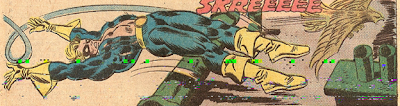


Robbins stayed with Cap for another year or so--and then with Roy Thomas he originated "The Invaders" --and left his mark on one of the first truly post-modern adventure groups in the Marvel canon He continued to produce "Johnny Hazard" until 1977. How he did comic books and comic strips simultaneously is beyond me. I lost track of his career--I've read he retired, quite happily, to Mexico after "Hazard". He certainly didn't need to hang around and take all of the crap heaved at him by irate fanboys calling for his head after Buscema left C.A. But I cherish those issues of Captain America, those dark and inky Batmans. I keep that work accessible to me in my studio-right along my copies of Kirby and Canniff and Eisner. I refer to it frequently---hoping a little of the life in his drawing seeps into mine.
But Frank Robbins was inimitable---and the qualities that make him great are those of personality and sensibility, they come around once and once only.
*"Batman" copyright DC Comics. images from Detective#426. Oct 1971. "Captain America" & "Nomad" copyright Marvel Comics. Images from CA. # 182 and #183, Feb. March 1974-75. apologies for the bad scans!
Monday, February 16, 2009
Look Out!Monsters at Comicmonsters.com
One of the nicer moments at NYC Comic-con was being introduced to
Rob Caprilozzi and his wife and their website: http://www.comicmonsters.com/ , where you will find everything you ever wanted to know about monster comics new and old. It's a terrific site, chock-a-block full of interesting material--particularly the "Making of..." feature--which highlights the creative process of just about everyone working in the genre of "Monster Comics" today. I've been asked to contribute a piece as well-and I'll be putting that together in the next few weeks.
Meanwhile---The Big Bad Wolf asked me some questions about "Look Out!Monsters!"-
and that interview is right here:
http://www.comicmonsters.com/features-988-Geoff_Grogan_talks_LOOK_OUT___MONSTERS.html
So check it out!
Wednesday, February 4, 2009
Life after Previews
Leave it to me to start a publishing company during an economic avalanche and at the same time that print is sounding its death knell. Not to mention that the largest single comics distributor is effectively eliminating the small press from its catalogue( a development that seems to be welcome to everyone but small press publishers).
Yet is strikes me that Rahm Emanuel has it right when he says that every crisis offers an opportunity (or something to that effect) and for those well positioned, now would seem to be the time for the establishment of a serious and distinct small press/alt-comics distributor.
What would that look like? For starters, I imagine an online only catalogue;-a fully functioning, well maintained and attractive website that presents its vendors well and is user-friendly for retailers and potential customers. In order to draw customers to the site it would have to offer at least a few big independent publishers and a number of well-known independent creators. There'd have to be a big promotional push, advertisements and interviews, signings and events.
I'm not a distributor, nor do I know the intricacies of coordinating hundreds of publishers with thousands of retailers. It takes organization, a good chunk of money and decent technology. It takes more than one person in the office. But there are people out there doing this already-it would seem that now is the time to step up the effort and while it sounds crazy, put some money into the enterprise. It might require small press publishers to pay some kind of annual fee-$100. or so-as in a co-op. Obviously this wouldn't cover expenses for the distributor-but it might fund the website. and that's a start.
Easier said than done, no doubt. But as the mainstream has its single source in Diamond, perhaps if there was a single source for alt-comics, interested retailers, art galleries and bookstores would be able to locate and order our work easily.
Freedom from the mainstream might also encourage the cultivation of a broader array of retailers. Jettisoned from comics shops, alt-comics might begin to find a place in galleries, bookstores, coffee shops and other venues. The model exists, undergrounds sold out of head shops-why shouldn't alt-comics sell out of bookstores and art galleries?
My feeling about Ka-Boom ( the POD printer that has recently announced a direct-market distribution service) is that there are too many limitations. Distribution with Ka-Boom requires printing with Ka-Boom and while that works for some things, I couldn't have done "Look Out!Monsters" or "Nice Work" under those circumstances. No, I don't think tying POD to distribution is appropriate to a movement that seeks to break with the norms in all manners of packaging and content.
These are random thoughts, not fully thought out, admittedly--but the important point is that there exists an opportunity in the fallout from this economic wreck. What form it will take-that has yet to be determined. More web-comics? you bet. An "Image"-style publishing house for art-comics? Hey-that's a whole 'nother post. But ideas are flying now--and its time to contribute to the discussion.
While the dust continues to settle-I'll be in Artist's Alley at the NY Comic-Con this week--with the entire line of L.o.M. books--"Look Out!Monsters (made it onto another "best of 08" list! check out Adam McGovern at Comiccritique.com ), Nice Workand Dr. Speck, the all ages alt-comics "super" hero (well-- his head inflates, what kind of power is that?)--and I'm introducing some brand new posters. In these dour times, I'm looking to have some fun--and what better place to find it than at the Javits Center this weekend?
Friday, January 16, 2009
Patrick McGoohan
There was nothing like "The Prisoner" on television in 1968. There is still very little that compares to it today--in its deliberate quirkiness, its refusal to follow the established formula of the 6o-minute teleplay. Imagine the staid audiences of 1968-trained on "Gunsmoke", "The Andy Griffith Show", "F Troop", even the "Man from U.N.C.L.E." and --tuning in to "The Prisoner". More than one viewer probably called their station to complain--or maybe called the TV repairman to get their "regular TV back on the screen".
I was 8 years old in 1968, left alone during summer Saturday evenings--and "The Prisoner" fascinated me. Man it was weird-soooweird. And creepy. What the hell was that big latex ball? Gave me nightmares-still does.
And that concept--falling asleep, waking up in your own apartment--but transported to an entirely different place--how cool was that? I remember looking out my bedroom window wondering if I really was where I thought I was.
'Good question.
McGoohan gave no quarter in that series, he never succumbed to the conventional demand for closure-revelling instead in the ambiguities raised by his premise, and engaging the philosophical complexities of the post WWII cold-war society we were creating. And if you shared his dark sense of humor-"the Prisoner" was funny -like a knife.And colorful--love those umbrellas. The 'ending" to the series is no ending at all--a maze within a puzzle within a riddle--it answers nothing and yet confirms our worst expectations. Did Six escape? Is there an escape?
It's the narrative possibilities that stay with me today. The questions the series raises-about individuality, about the social collective, mind control-media control; the symbols McGoohan utilized to engage difficult ideas in an entertaining way.
I'm not hopeful for the new series--"The Prisoner" was the result of one man's vision. And like any work of art, there's no recreating it--why bother? It's like trying to repaint Matisse.
So I imagine they should have a parade to celebrate Six in Portmerion. Bring out those rainbow umbrellas, march in unison throughout the square-chanting"SixSixSixSix".
Patrick McGoohan would've hated that. and that's as it should be.
Be seeing you.
Monday, January 12, 2009
Ditko's World
Whew! I just finished Blake Bell's Strange and Stranger: The World of Steve Ditko--and not soon enough. Not for any fault of Blake Bell's-who has produced an attractive, detailed and insightful tome on Ditko's 50 -odd year professional career. Rather, I'm relieved to be free of Ditko's oppressive worldview, so thoroughly conveyed via Bell's comprehensive research and analysis.There are points-particularly late in the book-where I wanted to scream-- at Ditko's intransigence, obstinance, --his complicity in his own martyrdom.
The artist who emerges within this text is difficult, self-destructive and self-aggrandizing- with an apparent disdain for his audience, fans, and the early career creations for which he is justly revered. His sense of his own righteousness and the perceived failure of his readers, co-workers, collaborators--oh, just about anyone within striking distance-- to live up to his(and Ayn Rand's) moral code is suffocating, effectively ensuring the artist's isolation and long artistic decline-- and perhaps that's the point. Was there something in his make-up that made these circumstances an inevitability?
There is plenty of room for analysis of the personality within these pages, but alas, if Mr. Bell has entertained any ideas in this regard, the reader is not privy to them. Aside from the descriptions of Ditko's early life in Pennsylvania, there is scant biographical information presented here.While Bell has covered Diko's public and professional life in detail, charting creative differences, office interactions, editorial discussions and the like across every phase of the artist's career, the man outside of the office remains remote.
Has Ditko ever formed any romantic attachments? Has he been heartbroken? Cared for elderly parents? Does he have kids? What about relatives? Relations with his siblings, nieces, nephews? Does he like cats? dogs? Is there anyone who can speak well of the man? Has he ever been known for acts of kindness, of generosity--of any kind? What kind of deprivations has his isolation imposed on his life? What was it in his life that made him so susceptible to Rand's stark philosophy--and to super-heroes? Is there more to him than the bleak and unforgiving Rand-acolyte described in this book?
These are not questions asked out of prurient interest. They fulfill the basic requirements of biography-to help the reader understand the motivations and choices of an important artist. Even if Ditko's personal life has been uneventful---that observation would merit inclusion here.
That said--Bell has given us an interesting and detailed overview of the artist's professional life and his half-century career-all in a very attractive package. Bell reveals Ditko's early influences and examines Ditko's artistic development, pointing out both the highlights and the low points of Ditko's long career with a critical eye and leaving the reader with a good understanding of Ditko's continued importance and the reasons for his decline.
And Ditko's best work shines--those Warren pages alone are worth the price of admission--and examples from each phase of Ditko's career are represented here and given quality reproduction on big, big pages. Much of it is a joy to look at. Much of it is a reminder of lost potential. As one scans images of Shade or Stalker, Bell's descriptions of the many fruitless editorial discussions between Ditko and those who hoped to hire him late in his career become palpable; the frustrations real.
This is a book I will look at again and again, and refer to for insight into Ditko's work - that is for certain. But questions remain. Towards the end of the book Bell describes a striking scene in the artist's studio wherein Ditko stands over a cutting board apparently cutting up original artwork from the 1950's, valued in the thousands of dollars, rather than trust it to the vagaries of the open market or to exchange with a colleague.
Who does that? Who is this guy?
Friday, January 2, 2009
Btwn the Lns 2: questions and answers;Hopper and Rockwell


In interviews over the years Neal Adams has voiced his admiration for the work of Norman Rockwell, describing him as a consummate story-teller. On that score you get no argument from me-- or those zillions of other calendar/poster purchasing consumers. Rockwell's continued popularity resides in the clarity of his narrative, the familiarity of his characters and the innocent humor with which he presents depression-era America.
Every aspect of a Rockwell image contributes to the story he is telling--from the obvious details-- such as the facial expressions of his characters, their postures, the clothes they wear--to those that are more subtle;-- the time, the place, the details of the setting. In Rockwell's world- all of the elements are explicit--so that there is no mistaking where, when or what. This explicitness extends to the manner by which he handles his materials as well, reigning in any expressive capabilities of his brush and paint, lest they clutter the canvas and distract from the narrative.
The painter Edward Hopper also mines the terrain of that period-and while he is certainly admired, it would seem odd to say he was popular. He too tells a story, and depicts an America that is familiar --and while one could repeat many of the same words used above to describe Hopper's use of detail- the end result is something quite different. And that difference resides in Hopper's inclination to be circumspect, to imply rather than explain.
It would be a mistake to say that Hopper simply plays with ambiguity for its own sake. His images are filled with questions, questions that arise not only because of his discreetness but also because of his interest in the ineffable, his deep feeling for light--and time. He uses paint to encapsulate the mystery of light upon a door , not to paint the door.
Rockwell's narratives-as pleasing and comforting as they are--conform to well-known archetypes, to an idea of a mythic America that is well-known. Every thing he depicts is complete, defined-- according to the needs of his narrative -and his audiences'expectations. He uses paint to satisfy expectation-- to define his objects, settings and people so well that questions are resolved apriori .
It is not only this-but the character of the questions Rockwell addresses: "what does an archetypal awkward teenager(of the depression-era) wear on a prom or first date? Where would they go? Who would be there? What would they say? How would they interact? What kind of soda would they drink?" -- that are both the source of his success as an illustrator--and the limitation of his art.
With Hopper we are left to wonder. The place and time are familiar to us-we recognize the light of morning, the brownstone rooftops. But the light-- seems not to define setting so much as to penetrate the inner life of the figure, to illuminate the relationship between the figure and the ineffable; inquiry and contemplation, the known and the unknowable.
Subscribe to:
Posts (Atom)